

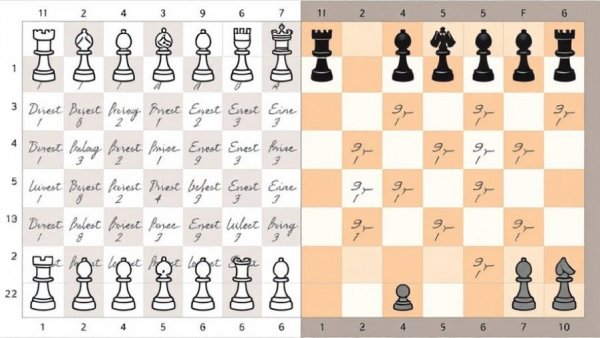
Revolutionizing Handwritten Chess Score Digitization with Zugwise
In the intersection of artificial intelligence and the timeless game of chess, a significant breakthrough is emerging. Researchers at the University of Toronto have developed a groundbreaking tool named Zugwise, which aims to enhance the digitization process of handwritten chess scoresheets. Traditional methods of digitizing these scores often treat the challenge as mere handwriting recognition, focusing only on identifying the moves represented in the score. However, this approach falls short in identifying critical errors that may silently alter the game’s outcome.
Understanding the Limitations of Current Recognition Systems
Current systems tend to prioritize the legality of moves, reading inputs without considering the strategic context. A misinterpreted move that results in a legal play can go unnoticed, potentially skewing the entire game reconstruction. Zugwise shifts this perspective; instead of merely validating moves, it incorporates a comprehensive framework that asks whether a human could plausibly have made the particular entry. This innovative approach not only identifies blatant errors but also uncovers subtle discrepancies that could lead to significant misunderstandings in game analysis.
How Zugwise Leverages Chess Knowledge to Detect Errors
Zugwise employs sophisticated chess strategies such as quiescence search and pin detection, which allow it to evaluate moves beyond legality. An absurdity detector within the system raises red flags for errors, enabling a backward search to trace discrepancies back to their origins. This means that when errors arise during game reconstruction, the system can pinpoint the exact moment they began, offering invaluable insights into the game’s trajectory.
Empirical Success in Real-World Applications
In trials involving oracle replay of chess tournament sections, Zugwise has shown remarkable effectiveness, reducing silent errors from 16 to just 1 in one section and from 50 to 13 in another. These improvements in accuracy highlight the potential for Zugwise to transform how tournament directors, coaches, and players review games, offering a higher fidelity to the original play than ever before.
Free, Private, and Fully Functional: Zugwise's Accessibility
One of the compelling aspects of Zugwise is its operation; the entire system functions seamlessly in the browser without requiring constant internet connections, ensuring privacy and ease of access for users. This focus on accessibility makes Zugwise not just a tool but also a platform that can democratize chess analysis for players at every level, from novices to grandmasters. Moreover, its three-way adjudication protocol is set to resolve conflicts where no single record can be deemed the absolute truth, thus enriching the community’s approach to game analysis.
Implications for the Future of AI and Chess
The advent of Zugwise represents not just an improvement in scoring accuracy but also a pivotal moment in the intersection of artificial intelligence and traditional games. As AI continues to infiltrate various aspects of life, its role in understanding the intricacies of human behavior—such as decision-making in chess—could lead to broader applications in other fields like education, psychology, and even business strategy. With innovations like Zugwise, the potential for AI to assist in nuanced human experiences becomes increasingly palpable.
If you are part of a company navigating digital transformation, consider exploring tools like Zugwise for enhancing data integrity and accuracy in your operations. For a deeper dive into such innovations, connect with networks that focus on technological advancements in various industries. Join the conversation and learn more!




Write A Comment