

Silent Data Corruption: A Hidden Threat in AI Training
In the ever-evolving landscape of artificial intelligence, organizations are increasingly reliant on powerful computing resources for training complex machine learning models. However, a significant yet often overlooked challenge arises from silent data corruption (SDC), an insidious form of error that can go undetected during training. Unlike typical hardware faults, SDC involves scenarios where a GPU produces seemingly plausible but incorrect results, causing data integrity issues that could jeopardize the success of machine learning projects.
Understanding Silent Data Corruption
Silent data corruption is a phenomenon that emerges due to various factors, including manufacturing defects and silicon aging. The mechanisms behind SDC often involve specific compute units, such as the multiply-accumulate lanes of tensor cores, which, under high stress—be it due to fluctuating temperatures or voltage drops—begin returning erroneous calculations.
This failure mode is particularly problematic, as currently implemented integrity checks in distributed platforms do not account for these computational inaccuracies. Although hardware monitors can detect typical faults like bit flips or GPU driver errors, SDC remains elusive. Meta reported 6 cases of job interruptions attributed to SDC during a rigorous Llama 3 405B pre-training session on 16K H100 GPUs, an example that underscores the magnitude of this issue during large-scale training.
Proactive Measures: Enhancing AI Model Training
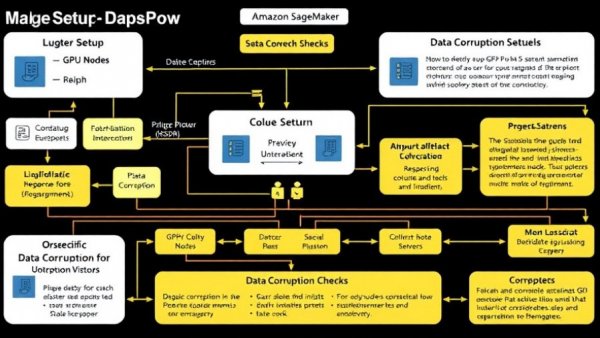
Fortunately, innovations in platforms like Amazon SageMaker HyperPod are addressing these concerns directly by implementing sophisticated detection methodologies. To effectively capture instances of SDC, SageMaker now integrates a series of checks within the training loop, designed to identify potential data corruption before it impacts model integrity.
The three key checks involve:
- Non-finite Gradient Check: Flags any GPU with NaN or Inf values in its gradients before data is shared across replicas.
- Ring Replay Audit: Every GPU recomputes the data from another GPU in the cluster, verifying values against expected outcomes.
- Weight Fingerprint Comparison: After the optimization step, replicas compare their weights for discrepancies.
These checks are invaluable, especially as they utilize the inherent capabilities of distributed training systems to localize issues efficiently without relying solely on external monitoring tools.
Practical Implementation and Future Insights
Implementing these checks requires a cluster orchestrated by Amazon Elastic Kubernetes Service (EKS) with a minimum of three GPU nodes, allowing for localizing errors effectively. Subsequently, failed checks trigger a node replacement process that ensures ongoing training efficiency. This robust automation allows organizations to anticipate and address SDC, significantly reducing potential downtime and associated costs.
Moreover, proactive detection of silent data corruption can transform the organization’s approach to AI projects. A model trained on reliable, validated data is more likely to deliver accurate results, leading to better decision-making and increased ROI.
Conclusion: Emphasizing Integrity in AI Workflows
As organizations leverage AI for transformative solutions, recognizing and addressing silent data corruption must be a priority. Innovations like the enhancements in Amazon SageMaker HyperPod and the strategies outlined demonstrate that thorough and proactive checks against data integrity issues are imperative for successful machine learning endeavors. Organizations must not only invest in robust training infrastructures but also maintain a keen focus on the subtle threats that could undermine their advancements. To optimize your AI workflows and ensure data integrity, consider exploring these cutting-edge methodologies and stay ahead in the competitive landscape of artificial intelligence.
For a deeper understanding and implementation guidance of these innovative strategies, contact us today.


Write A Comment